Pooncarie
Posted on May 2, 2021
Blog #7 – Pooncarie – Days 33 to 38 of 180
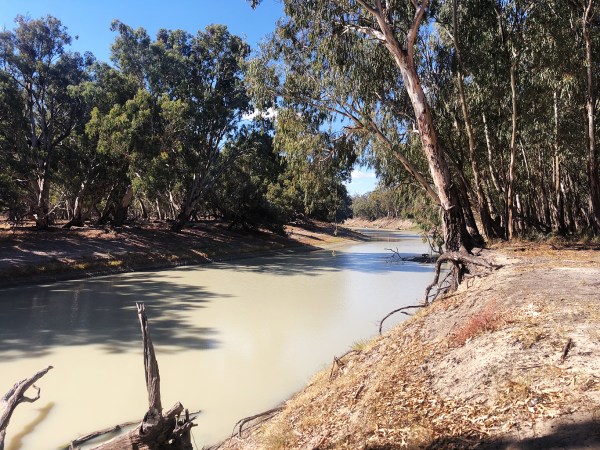
Pooncarie, which today is a tiny town on the Darling River, was known in the late 19th century as ‘The Port’. At the time it was a vital staging place for the river steamers which began plying the Darling River in 1858 en route for Menindee and Wilcannia. Today there is little more than a hotel, a store, a post office and several dozen people. However, it still hosts the Pooncarie Cup, a popular race carnival, every October.
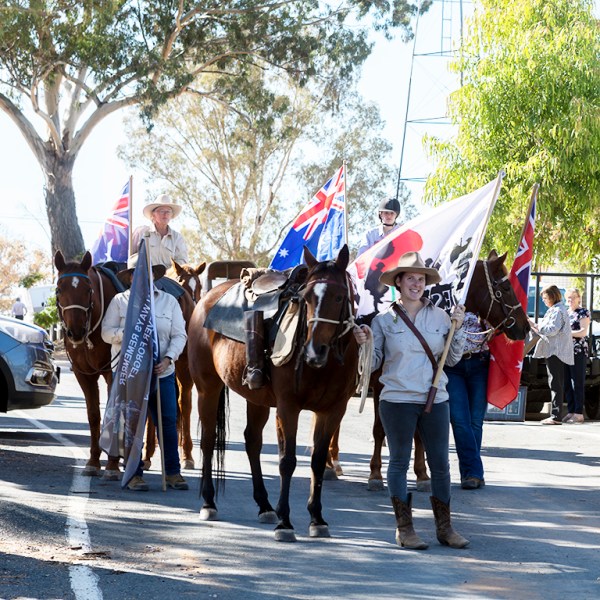
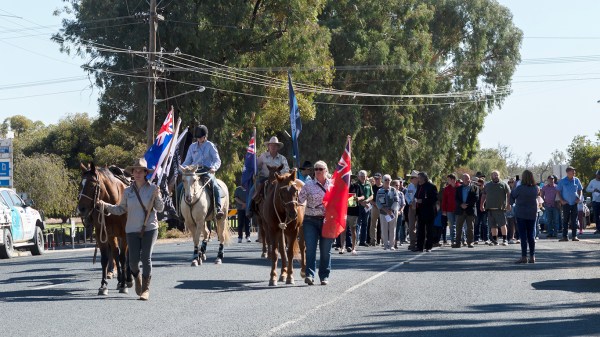
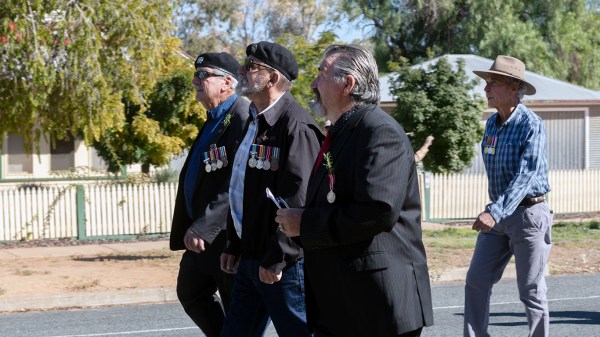
Our original intention was to only spend 3 days here but when our departure happened to fall on ANZAC day, I thought it would be disrespectful to not attend the local events on that day by travelling so we stayed an extra two days. Approximately 60 people turned up for the day to pay our respects to our returned servicemen and the loss of so many others in foreign wars.
This town has a close association to the wool industry during the boom years 1840 to 1890s. It was originally gazetted as Pooncaira in 1863 and the area was first ‘established’ by Europeans in the 1840’s as the settlers took up illegal livestock runs on crown land. By the 1860’s the government in an effort to gain control, formalised these illegal, and unfenced, claims. These lands had been home to the Barkindji people for 40,000 years and it is believed the original town name of Pooncaira meaning is “large sandhill” in their language.
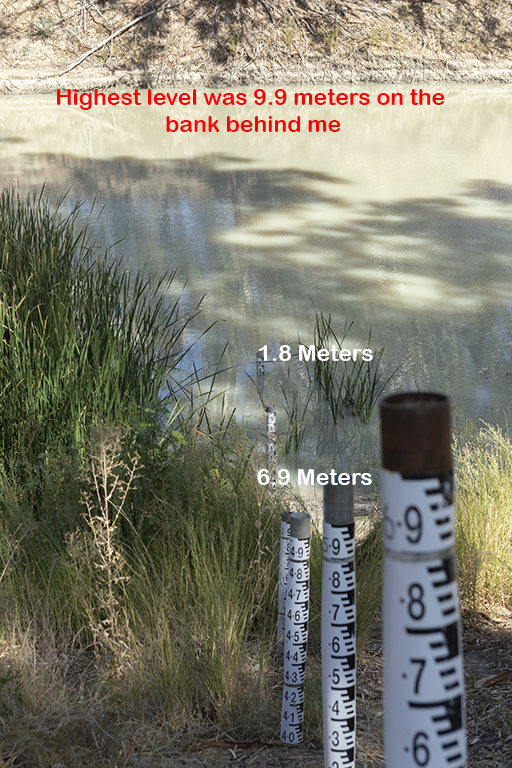
It was odd that the claim to fame for the town is called the ‘Old Wharf’ when not a stick nor remnant post exists today. The Darling River which runs through the town today is a sad reminder of the criminal theft of inland waters by large agricultural businesses to the north aided and abetted by NSW politicians. The Darling River doesn’t really flow here now with water restricted to 6klm North of the town and 8klm South between two weirs. It is also very shallow with a few deep holes but mainly around 1.8 meters.
Burke & Wills came through this area on the ill-fated expedition in 1860. More settlers followed and the town established itself as a service hub for outlying stations and more importantly, at the time, as a port for the paddle steamers that traded further up the river. The other claim to fame for this small town is the hosting of the Pooncarie Cup on the NSW Labour Day weekend when the town population swells from 84 to over 1500 for that event!
The campgrounds here are quite barren but very reasonably priced at $10 a day each. We have access to unlimited hot showers as the coin machine to control the shower length has been broken for the past two months (bonus for us!!!!) plus flushing loos.
Like all travel in the outback of Australia you do run into some unusual characters and we ran into two such characters. John Arthur Elliot the modern-day Camel Man (John Arthur Elliott – Adventurer, Entrepreneur & Motivational Speaker (johnelliott.com.au)). 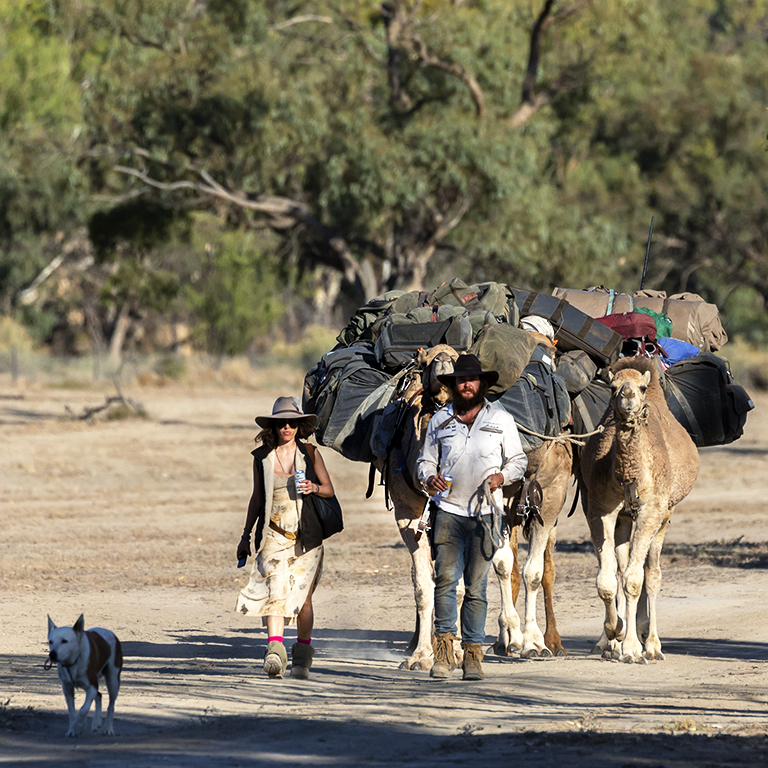 He was wandering the outback with a very charming companion who I did not get a chance to talk too and his (now) five camels. I enjoyed the music from the 60s, 70s and 80s that were belting out around a campfire although the singalong voices could have done with some improvement.
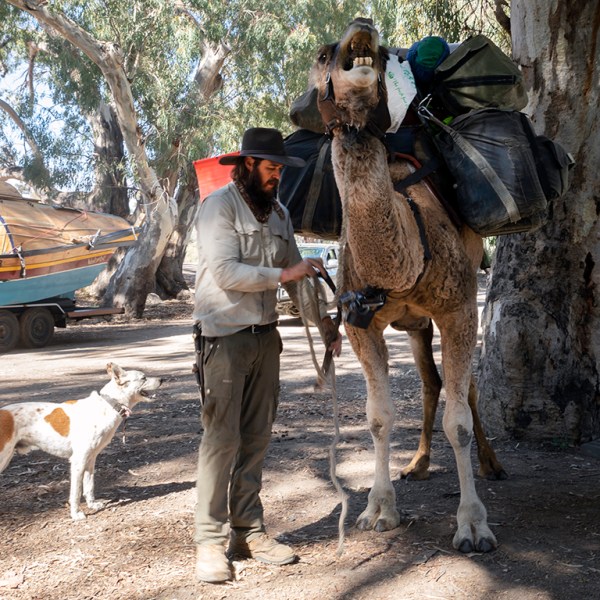
They were camped some way away from us but we most certainly heard them hosting a party some two hundred meters away with the crews from the Darling Baarka River Convoy – here is a link to one of the ladies on that trip raising awareness of the plight of the Darling River and a short 2 minute video on her vessel – Tuesday Browell Darling Baarka River Convoy.
Other interesting history from this region is about the cattle & sheep barons around this era around which legendary myths were created by men such Henry Lawson, Will Ogilvie & Breaker Morant. Kidman, Tyson & McCaughey created pastoral kingdoms of unparalleled proportions out here. The light horsemen of World War 1 fame were bred on these vast plains.
The other claim to fame for Pooncarie is famous for is the town’s involvement in the shearers strikes of the 1890s when scabs were bought in to undermine the local shearers. This was a time of high unemployment so recruits were easy to find. Just to the north of the town a group of local shearers boarded the PS Rodney and evicted/evacuated the scabs, crew & passengers onto a nearby island and then decided to burn the vessel as a lesson to others. The wreckage lies on the bottom of the Darling River 8klm downstream from Polia Homestead. No one was ever convicted for the arson. It was a hectic time in Australia and was the time when the Labor movement and unionism grew. I am a great believer in getting a fair go and have never liked one sided workers agreements that favoured the wealthy so have no sympathy for the boat owners of that era who lost out when the insurers refused to pay for the loss of the vessel.
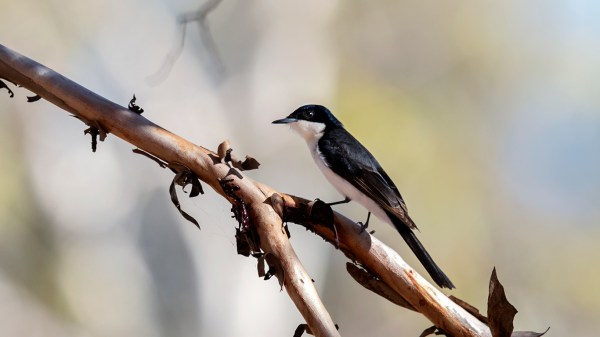
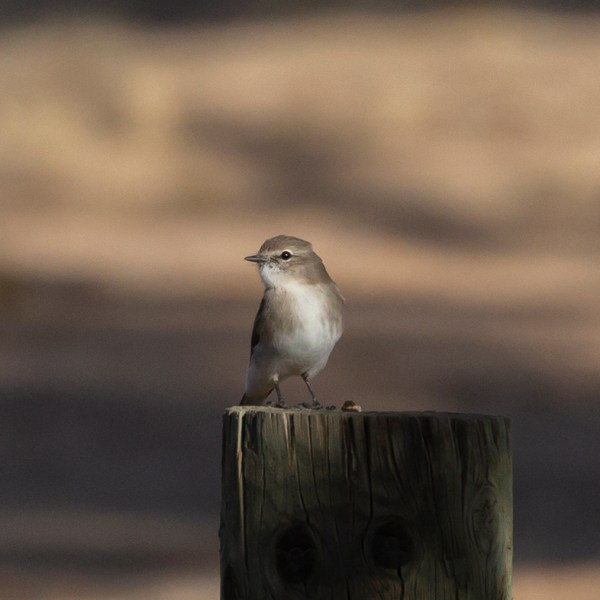
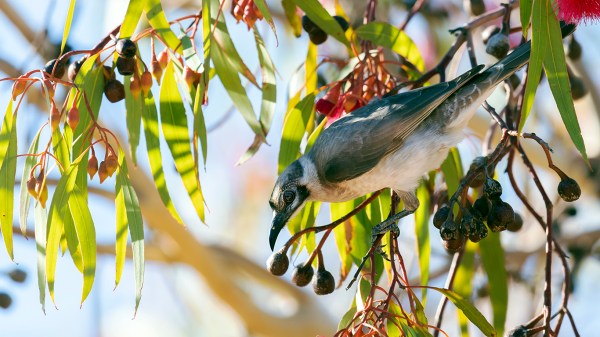
I am now starting to see what bird photographers call “lifers” – never seen before by that photographer. Around our campsite I have now photographed a Jacky Winter, Spiny-cheeked Honeyeater, Striped Honeyeater, Little Friarbird (lifer) & a Restless Flycatcher. Also spotted White-plumed Honeyeaters, Mallee Ringnecked Parrots and Galahs but no good photos.

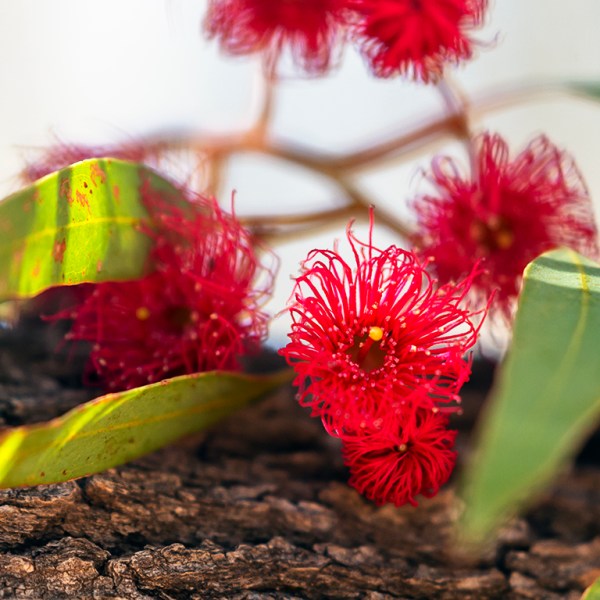
Corymbia ficifolia (Red Flowering Gum) 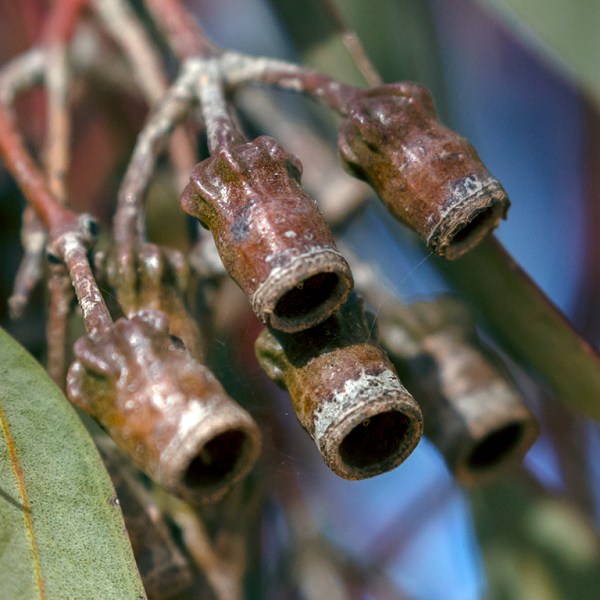
Corymbia ficifolia (Red Flowering Gum) Gumnuts
Last night at this camp we lit the fire and had toasted marshmallows as a treat. 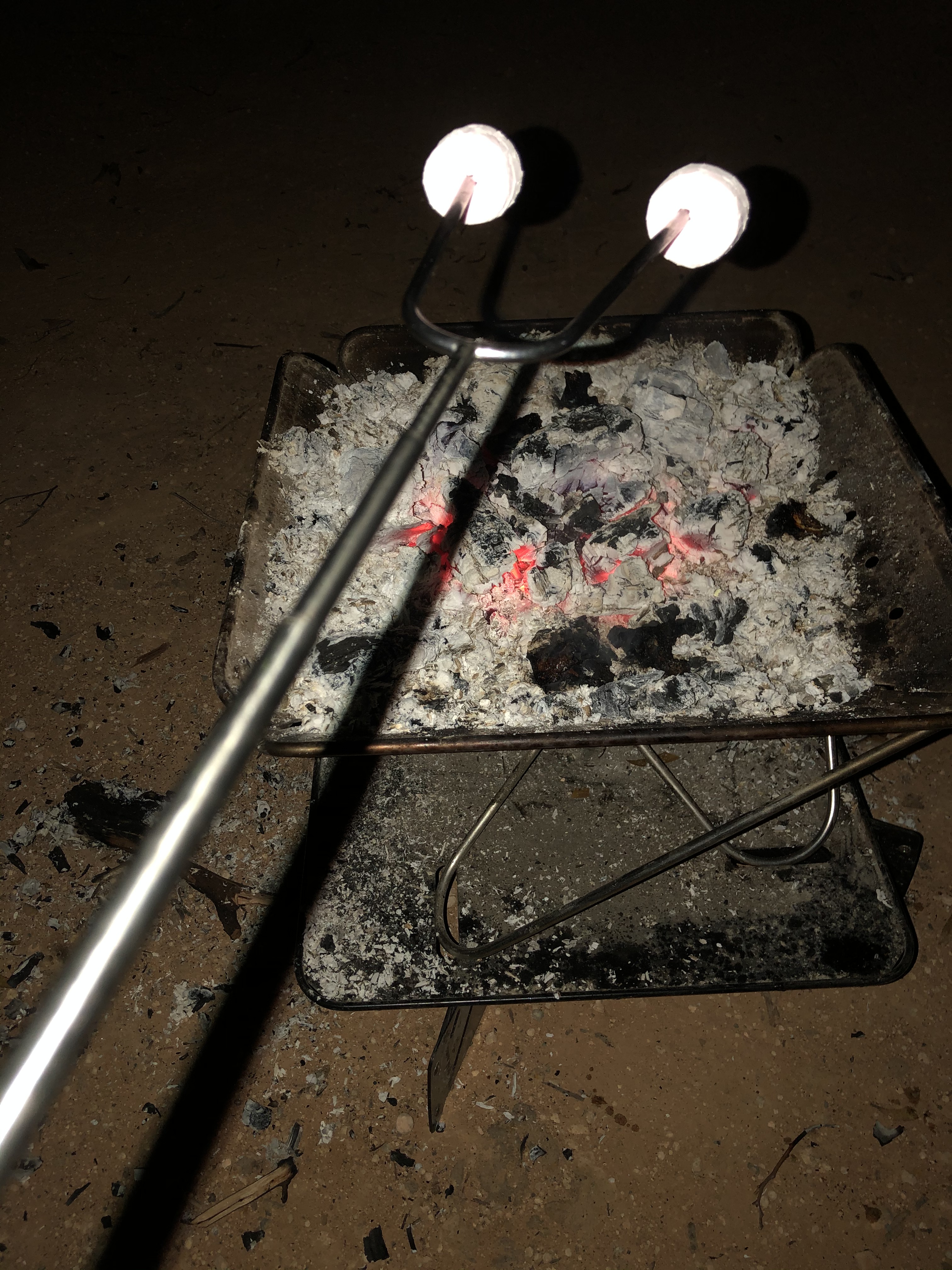
It was time to move on to the next part of the adventure at the Menindee Lakes. Our new home for five days would be on the Darling River campground in Kinchega NP.
Mungo NP
Posted on April 26, 2021
Mungo NP – Days 30 to 32 of 180
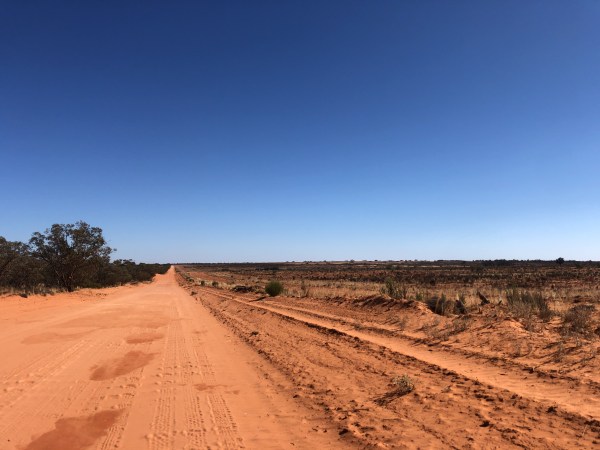
Although sad to leave Bottle Bend it was off to a new adventure to see the sights at Mungo NP. I had read so much about this place before we arrived there but nothing had prepared us for the road in. The first 20 klm from Buronga to Mungo had lulled me into a false sense of security with a lovely tar road. After that it became the bone crunching corrugations that you read about in Outback Magazines when they talk about the Gibb River Road for the next 100 klms. Top speed was under 80 klms per hour and many stretches down to 40 klm per hour. Corrugations and lots of bull dust! For those who haven’t travelled on Australia’s bush roads may not be familiar with what we call bull dust. “Bulldust or bull dust is a fine red aeolian dust which is especially common in the Australian Outback. It is formed from dry particles which measure less than 2 microns and so form a choking cloud when disturbed. It is a particular hazard when driving as it may conceal dangerous potholes or reduce visibility.” – source Wikipedia.
The 124 klms to the Main Campground took us 2 ½ hrs and we were in dire need of a beer by the time we got there. We were only here for two nights as I had found out that the loop road has been closed for maintenance and there were only 3 spots to visit – the Information Centre, The Main Walls of China viewing platform and the Red Lookout.
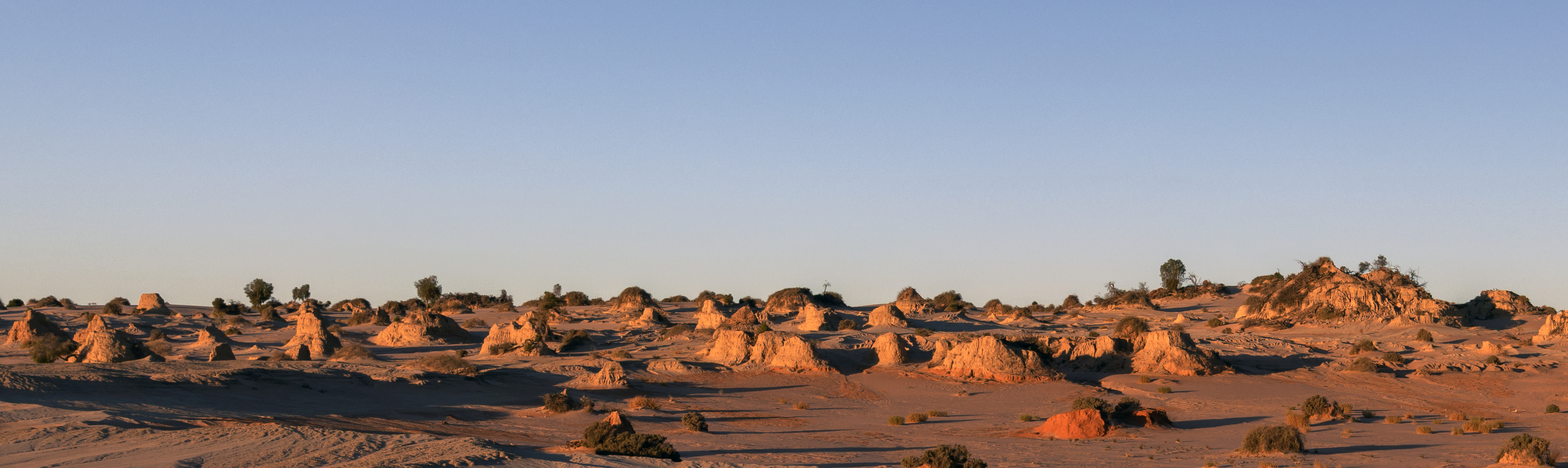
Setting sun on the lunettes
My pick was the Red Lookout as you were much closer to the sandstone formations. The roads to and from (20klm from campground to the lookout) were very corrugated and dusty and you had to keep an eye out for the wildlife which to my surprise included feral goats.
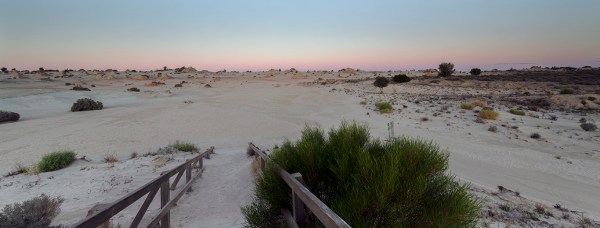
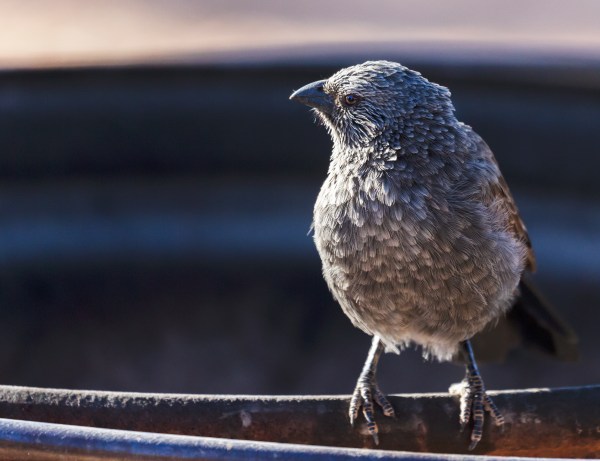
We saw Western Grey Kangaroos which are much darker than the Eastern Greys near my home and a mob of Emus. In the distance I saw a small flock of Major Mitchell cockatoos to far away for a photograph plus Apostle Birds, Blue-faced Honeyeaters, Crested Pigeons and the ubiquitous crows.
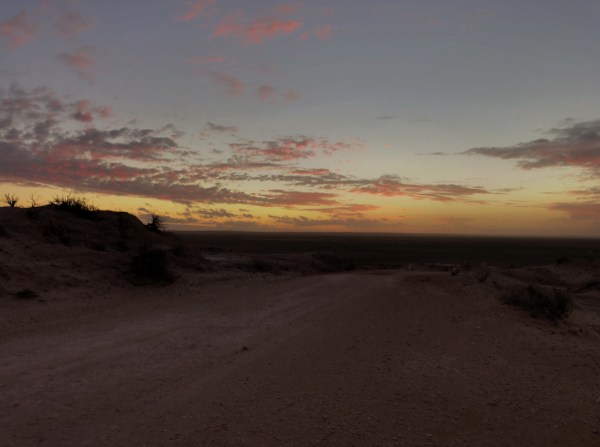
The main Campground only has 33 camping spots and bookings are essential. The cost is $24 per day each plus $8 a day for park entry. We opted for a year pass at $45 so we could enter any NSW park (except Kosciusko) as it was better value knowing that we would stay at Kinchega NP near Menindee in the coming weeks. The weather was now getting colder with night time temperatures down to 3 degC but daytime a very pleasant 21 degC. That was if you could get out of the wind. Thanks to our apps Willy Weather & BOM we knew that on day two we would get strong winds up to 60 klm/hr and dust. We double pegged our awnings down and tightened all the guy ropes.
Crisp nights make for good sleeping especially under a 5-blanket doona! The wind howled all night but died down in the morning. We had new arrivals the next morning who camped across the road from us and their old caravan had taken a beating on the road in. The side window frame had fractured and the glass broken and the van was full of dust.
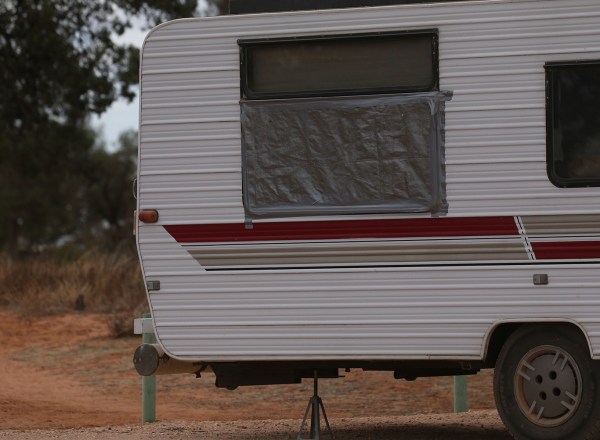
The elderly couple (late 70s) were not prepared to be out there that was for sure. One thing most travellers will do in Australia is help others so Greg and I armed with an old silver tarp and a reel of 100 mph tape went over to help patch the old van up as they had nothing to repair it themselves. I also loaned them my Ryobi mini vacuum cleaner to help remove the dust from the interior. Tony & Pamela were very grateful for our kindness. I could not believe that he had only been discharged from hospital the previous week and then purchased a brand-new VW Touareg to tow his 50-year-old Millard caravan which had no support legs nor a jockey wheel!! Amazing that he was using a bottle jack as his jockey wheel and two car stands as the support legs at the back.
The best part about the information centre were the hot showers even though it was 2 klm from the campground. I really did enjoy that part. We drove out to do a reconnaissance run for the best photographic angles for the first night. We could have paid for a tour to walk in and out of the sandstone formations but I could not see the value in that at $40 each or the bus tour for $130 each. For those who have never been here they are not huge edifices like you see elsewhere in the world but they are interesting and very weathered. There were three large tourist groups there when we arrived so I took some test shots as they were in front of me wandering around the rock formations. Call me unsociable but I do not enjoy large group tourism and would much prefer small groups of like-minded photographers when out and about. The sunset was fairly ordinary and did not light up the landscape as I expected it too but such is life. Tomorrow may give me a better result.
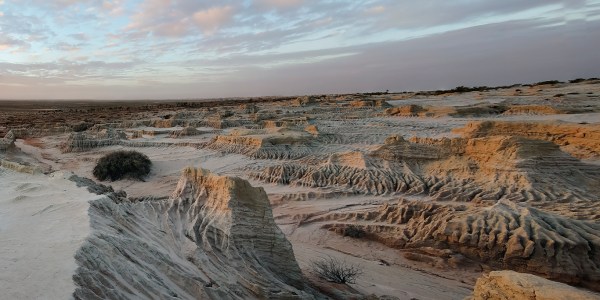
This is an excerpt from the history of the region: “The main attraction in the area known as the Willandra Lakes is Lake Mungo. It is a relic of life in Australia 30,000 years ago when the area was defined by a series of large, deep, interlocking lakes “teeming with large fish. The now dry bed of Lake Mungo would have been 20 kilometres long and 10 kilometres wide, with a depth of some 15 metres. On its eastern side sand dunes provided sheltered campsites by the lake shore” is the way archaeologist Josephine Flood described the area in Archaeology of the Dreamtime.
Aboriginal hunters and gatherers, accustomed to walking from water hole to water hole, settled on the shores of the lakes and established semi-permanent campsites where they could rely on the freshwater lakes for fish and crustaceans. The local fauna, drinking at the water’s edge, supplemented their food supply.
About 16,000 years ago, as the whole area became more arid, the lakes dried up. All that was left was a 25 km-long sand dune, called a lunette, which stretched along the eastern edge of the lake and was, in places, up to 40 metres high.
When shepherds, many of whom were Chinese, arrived in the area in the 1860s they called the lunette the Walls of China.
Today that landscape remains unchanged. Arrive at Lake Mungo and from the Mungo Lookout above the Visitor Centre (see my comments as I think the Red Lookout was better), you can gaze across the flat, barren bed of a long-departed lake with some heavily weathered sand dunes rising on the eastern horizon.
Lake Mungo’s claims are threefold. It has “one of the longest continual records of Aboriginal life in Australia” having been occupied for over 50,000 years. The skeletons found in the sands of the lunette are the “oldest known fully modern humans outside Africa” and, most importantly, the skeleton of Mungo Woman (or Mungo I as she is officially known), which has been radiocarbon dated to around 26,000 years ago, “has provided the oldest evidence of ritual cremation in the world.”
Josephine Flood has written of the discovery: “It is interesting that it is a woman who was cremated. Although no conclusions can be drawn from a sample of one, it at least shows that 26,000 years ago women were considered worthy of complex burial rites. What emotions inspired those rites – love, fear, or religious awe – we will never know, but all show a concern for the deceased which is the essence of humanity.”
The way to make sense of Lake Mungo is to gaze across the dry lake bed, walk up the dramatic and unusual lunette, and silently contemplate the idea that once, tens of thousands of years ago, at this lonely, haunted place, Aborigines painted themselves with ochre, ate fish and mussels from the lake, buried and cremated their dead, cooked meat in simple hearths and ovens, sewed skins into cloaks and shaped bones and stones into tools and weapons. There is a unique magic about the place, a strange spirituality which is particularly apparent at dawn and dusk.
If you want to glimpse what life was like for Aborigines when our European ancestors were still living in caves then Lake Mungo is a genuinely unforgettable experience.”
Day two was lovely and crisp with no sign of the dust or the strong winds but we diligently checked that we had taken appropriate cautionary measures to protect our gear. Had a lovely decadent Royal Canadian breakfast – Pancakes made from scratch with real Maple Syrup and two slices of bacon washed down with Proper Strong Yorkshire tea. Yummo!!!! By late morning the wind had started to gust to 40 klm/hr and whipped the dust up from the campground. Knowing that everything was secure we drove out to the Red Lookout to see what the sunset angles I would need to get a good shot.
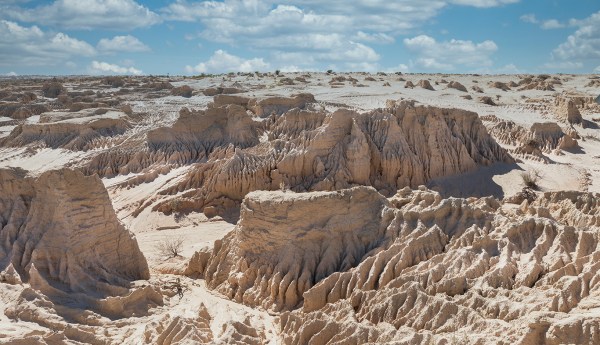
On arriving out there we had passed a small waterhole which I added to the memory bank to explore on our return. I was very impressed with the Red Lookout compared to the main lookout as there were some great photographic opportunities to look for at sunset. Looking back to the campground across the lake you begin to realise what a huge lake system this must have been in the past. We could see the dust storm approaching so headed back for lunch and to hunker down. We stopped at the small waterhole to find a group of five emus there for a drink but they were all very nervous except for the very large male who give us the evil eye as if to remind us this was his place. In the emu hierarchy the female’s sole responsibility is to lay the eggs and the male then incubates them and then raises the young by himself. In a true sense he has paid for his pleasure in time and effort.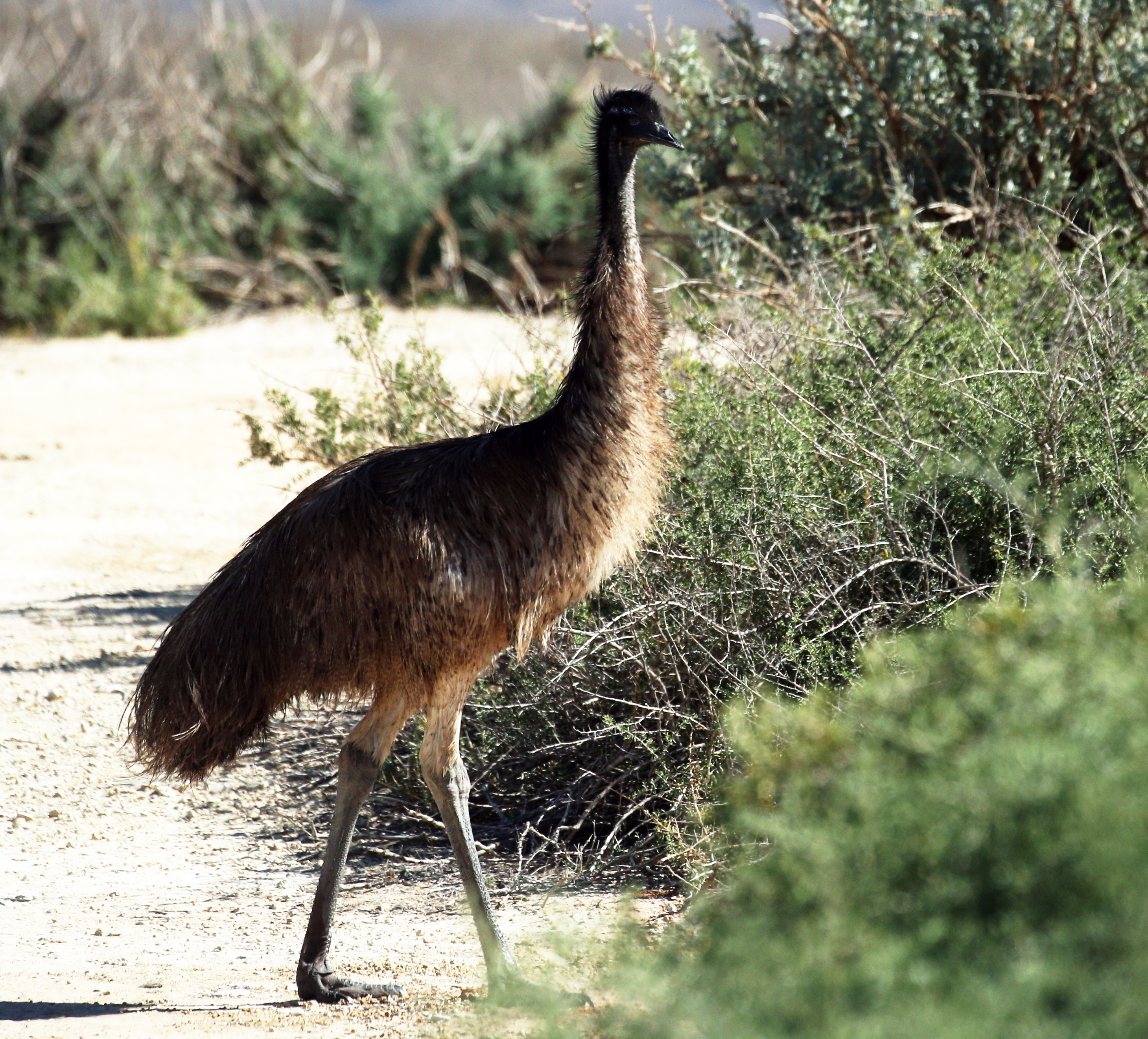
The wind howled through the campsite all afternoon and was rising when we left again for our afternoon showers then our sunset shot from the Red Lookout. On our drive over the lakebed the wind whistled over the flat landscape and the dust storm was growing in intensity which had the potential to ruin our sunset shots. The wind was very cold when we arrived at the lookout and as we still had an hour to sunset, we opted to sit it out in the car rather than brave the wind. This is where the road ends at the moment as the scenic tour is closed for maintenance which was disappointing.
Surprisingly the dust storm blew away in that one hour but the winds had got much colder when we braved it to do some photography. Satisfied with the short session we packed it in early as we did not get the light show I was expecting to see after the sun had set. I will have to come back another time when it is fully open and hopefully the lighting will be better as well.
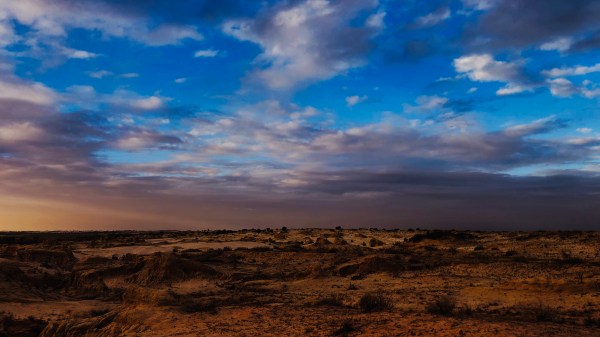
Back to camp for dinner and an early night as we were to leave in the morning for Pooncarie. The other major reason we did not stay long was that I had a long drive back to Swan Hill to pickup my new solar blanket before we travelled any further north.
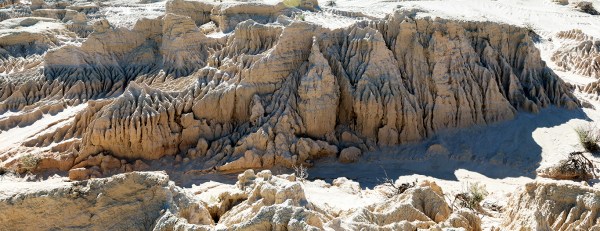
The next morning had us awake early to very crisp weather but no wind. Time to pack up and hit the road again. A last couple of snapshots of the Apostle Birds and a failed attempt as a photograph of a juvenile Western Grey Kangaroo but alas he/she bounded off into the bush. To add insult to injury I tripped over a tent peg and landed heavily on my elbow. Clumsy bugger I am. A very large bruise to remind me of my visit to Mungo NP.
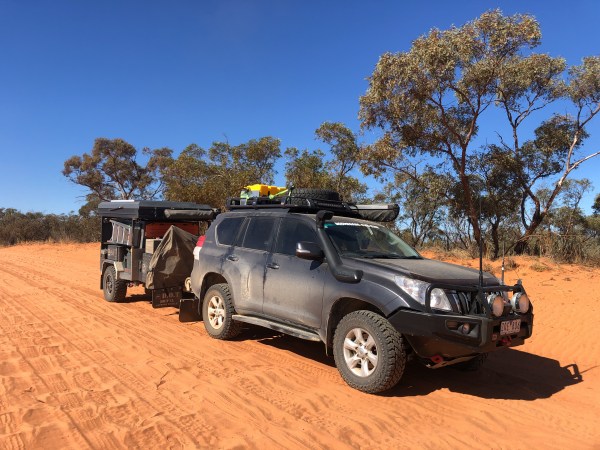
This day’s travels were going to be quite short as it is only 84 klms from Pooncarie but 50 klms were bone jarring corrugations and choking clouds of bulldust. This is only preparation for when we get out on the Oodnadatta Track and parts west later in the trip.
The good news was that my new solar blanket had arrived at Shepparton and they were looking at how to get it to Swan Hill for me.
Farewell Mungo NP and Pooncarie here we come………
Farewell to Bottle Bend
Posted on April 21, 2021
Bottle Bend – Days 19 to 29 of 180 – the wait is over
Not planned for but we have extended our stay at Bottle Bend as we have struggled to get booked into the places we want to travel too. No biggie as this place is quite pleasant with not much happening. Gives me more days to sit and plan our trip much better before we get to SA & NT. Our plan was always to free camp as much as possible but I am seeing some very interesting station stays out there which look very good and not that expensive.
A bit of excitement yesterday late in the afternoon when we heard 5 rapid shotgun blasts across the river from us then a fire started in the cambungi reeds alongside the river that spread into the forest. In the end we had 4 CFA fire tankers plus 5 other CFA utes and the police attending. Not too dangerous as they knocked the fire down in about 10 minutes. We sat in our deckchairs sipping beers and enjoying the show.  There were three caravans camped up about 200 meters from the fire who were not perturbed at all which we thought was rather careless of them.

Today we did a small trip up to Wentworth as Greg had never seen the confluence of the Murray & Darling Rivers. These are two of Australia’s largest river systems and it was interesting to see the confluence as their colours are quite different. 
I didn’t take any shots that day as I had been here before. However, we also discovered the Perry Hills just outside of town a small area of constantly shifting sand dunes that originated 40,000 years ago. Quite pretty but obviously people cannot read the “No Vehicles on Dunes” signs so all the stupid inhabitants had made a mess of a very picturesque area. I know this is a bit of a rant but this type of casual carelessness gets us locked out of such areas which is very frustrating.

Greg has bit the bullet and upgraded his solar blanket to a 300W model which gives us more confidence that we can now keep his battery up to charge. It seems we go on about lack of battery power but it is a real issue if you are living off the grid and that battery needs to supply all your power needs. We also need to pay more attention as to how we orientate the camp as my solar panels are fixed and when the bed canopy is raised, they need to face North to get as much sun as we can. They currently face South so are not adding any power to my battery – that is 380W of solar I cannot utilise. My bad! I have a Safiery high energy 250W solar blanket that gets me too about 93% each day and overnight usage is around 20% so I am OK. Greg’s system for some reason is chewing through twice that. The only major difference is that I am powering an EverCool 60 litre fridge/freezer and Greg’s is a TravelMate TMDZ 95 litre.
Our plan was to move on by now but we are awaiting our Seniors Flu Jab which apparently is in short supply in Mildura. I am also awaiting a spare part for my Weber Q fry pan as the handle has shattered. Weber seems happy to give me a replacement just waiting for it to be shipped to the Mildura agent on Monday or Tuesday. Flu jabs now done and the Weber part has been supplied. Happy Days.
Had a large windstorm tear through the camp yesterday and the dust was flying. My turn for a disaster with my Safiery 250W High Voltage solar blanket being knocked over into the dirt a number of times. Unbeknownst to me it is now damaged beyond repair so have had to order a new one. The agent in Melbourne, Jeff Crane, was very helpful in getting it sent to a mate of his in Shepparton who then can send it up to Mildura. Hopefully will be here after our short sojourn into Mungo NP. The trials and tribulations of travelling on the road and you have to expect the odd $1000 expense. Luckily my home & contents policy had sporting goods included with RACV so they paid for $687 of the expense.
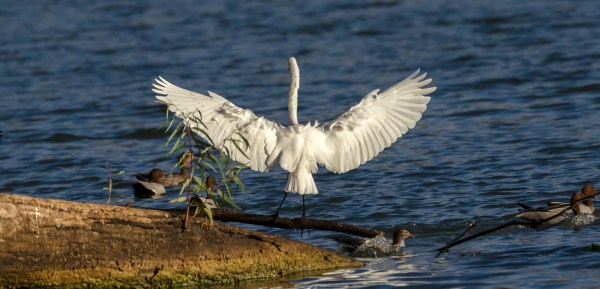
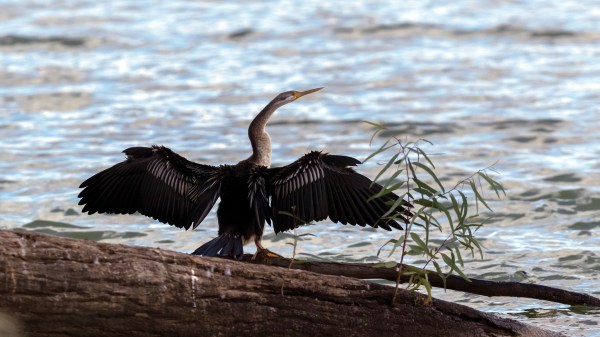
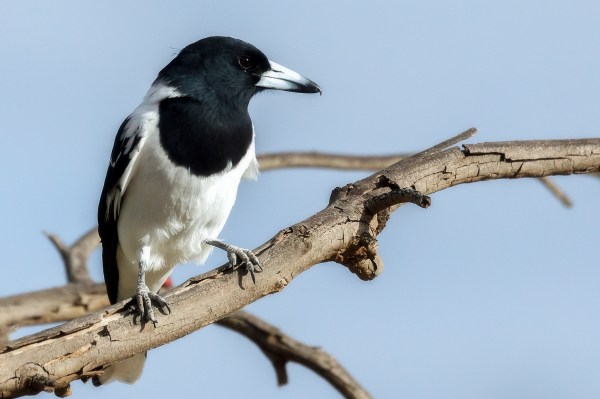
We had an entertaining afternoon feeding a family of butcherbirds with some meat I had inadvertently left out and had gone off. Their antics in beating the meat to death on the branches was quite funny. Maybe they were tenderizing it. In the end they were chased off by the magpies and a Mudlark.
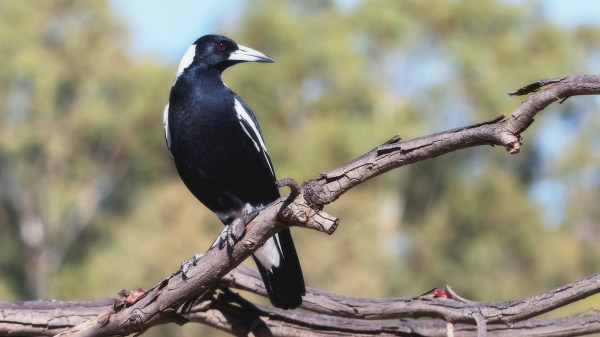
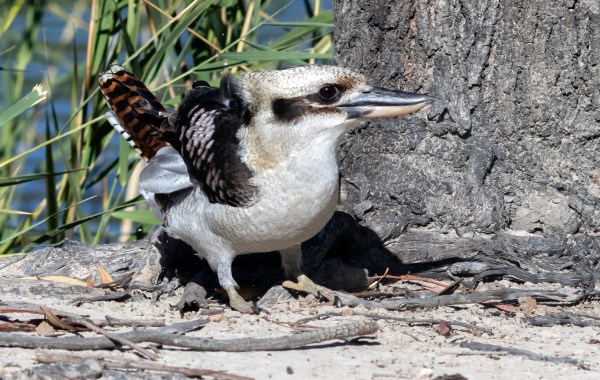
Not to be outdone a Laughing Kookaburra swooped in for his share and Greg managed to get an excellent shot of the bird.

A friend of mine from the camera club, Tim O’Keefe and his wife Denise paid us a visit in our bush camp. They bought us a banana bread cake which was very welcome (and tasty). Very thoughtful of them. They continued on their way to enjoy a holiday down in Adelaide.
One thing I never enjoy about camping is the packing up so this time I am doing pre packing two days before we leave on Monday the 19th. Car is now repacked (for about the 10th time). I need to pack less or get a bigger vehicle!!!
One thing I have not enjoyed about camping here has been a mongrel dachshund that constantly barks across the river. Harvey you were so lucky that you were too far away for me to give you a swift kick up the bum for your terrible behaviour. I also blame his owner for not raising him correctly. All day long I would hear Harvey to the stage that I began shouting vitriol across the river at his owner to control the mongrel.
Due to my new solar issue, I am forced to lower the roof of my bed down each day so that I can utilise my rooftop solar panels. Whilst a slight inconvenience it makes a huge difference to have those 380W of solar panels working for me with the battery topped off to 100% by midday each day.
I will come back here one day as it is a very good campsite (even if the sign says overnight only) as it is very peaceful. Being a free camp, it keeps the expenses down. Also handy being only 25klm from a major inland city of Mildura so we can nip into town to replenish our red wine stock (thank you Dan Murphy’s) and pick up fresh groceries.
The fishing could have been better but we have caught three small cod (safely returned to grow bigger) and three carp (despatched and put out into the forest to become food for the monitor).
The weather is turning much cooler now even though we are experiencing sunny days around 21 degC. The wind from the south is relentless and cold. Night time temperatures are down to 5 degC. Daytime wear is pajamas with a jacket with trakkie daks if we are not going to town.
Showers in the middle of the day to take advantage of the suns heat on my shoulders. Major difference between the camper trailer and the caravan is that my shower is external and the wind blowing in can be very bracing to say the least.
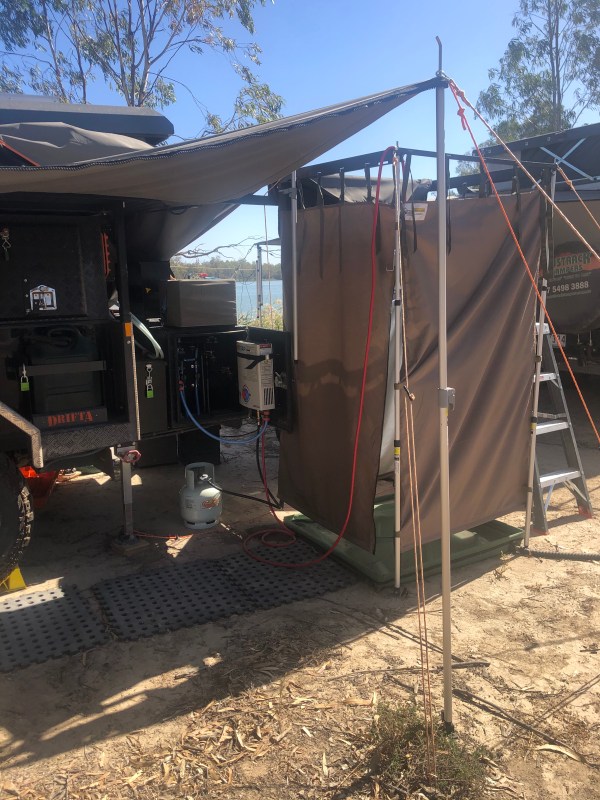
Looking forward to finally getting to Mungo as it has been quite a long wait here (17 days). The next time we will stay this long in one place will be at Kurumba in North Queensland.
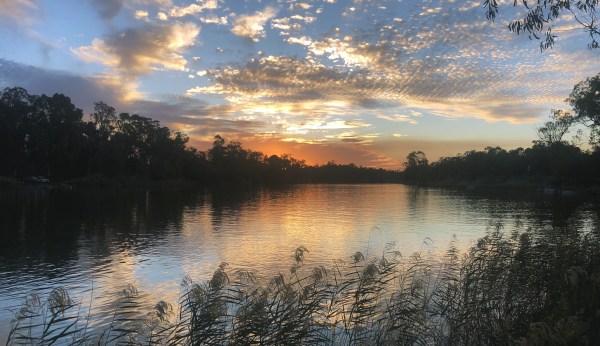
So farewell Bottle Bend and thanks for the memories especially the gorgeous sunset on our second last night.
Bottle Bend
Posted on April 7, 2021
Blog #4 The Hiatus – Days 10 to 18
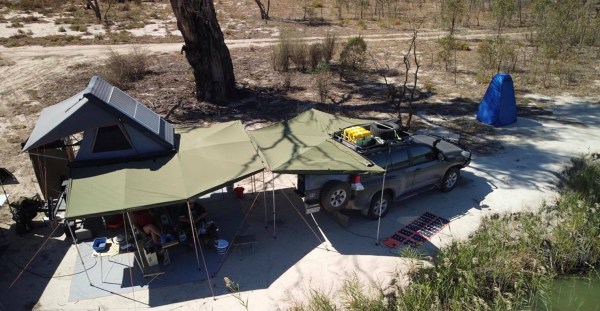
After leaving Lake Crosbie we had a need to sort out the solar issues that Greg was experiencing as we had serious concerns that his new 200ah Lithium battery would fail if we could not get power into it. Drove into Ouyen and started ringing auto electricians within a 100 klm radius but had no luck due to the upcoming Easter holidays. Decided to book into the Discovery Park Mildura for 2 days to recharge the batteries and do some washing. Rates were reasonable at $20 a night for unpowered sites right on the banks of the Murray river.

The only drawback to our magnificent location was the riff raff doing burnouts across the river on both nights. Apparently, this was a regular occurrence that is seemingly tolerated by the police as we never saw any police in this area to control this anti-social behaviour.
Greg rang iTechWorld in Perth to seek some help and after discussing the issue with them they suggested that the earth wires had not been connected correctly which he rectified. The bonus however was an offer from the local Battery World franchise who offered to come over and have a look at the issue with Greg’s caravan power. Very prompt service and the guy was there in 20 minutes and ran a multimeter over all the connections and confirmed that everything should be OK from now on. Also made some suggestions on how to refresh the Bluetooth software to ensure he was seeing the correct information. Problem now resolved; mission accomplished now to move on.
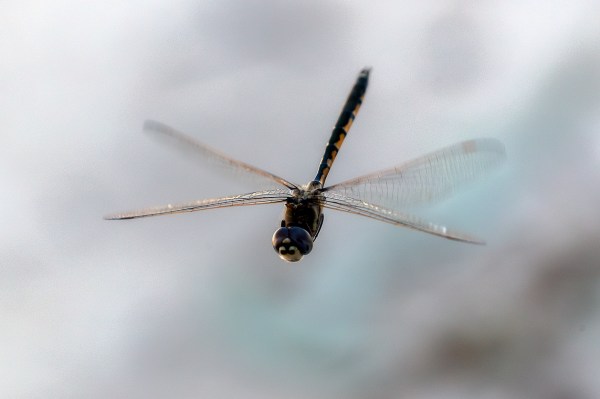
This is new for both of us to be out camping at Easter for the first time in over 25 years. In the past we have stayed home due to the crowds of people. It also coincides with the school holidays so everything we want to go to is booked out. Greg remembered staying at Bottle Bend in the Gol Gol Reserve on the Murray River years ago, it is only 25klm out of Mildura so we decided to hideout here for two weeks of fishing and relaxing. Found a perfect flat spot for our little convoy. The weather is unseasonably hot but if it gets too hot, we can jump in the river.
We could have moved on but the crowds will be in all our alternates for the next two weeks so it is easier for us to free camp on the river as the nearest resupply point is the small town of Gol Gol only 5 klm from our location.
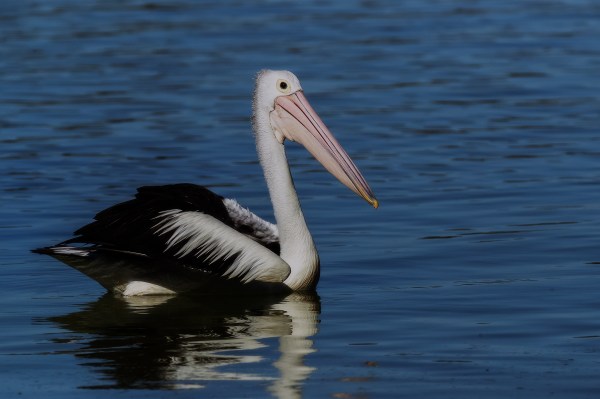
Across the river we have party central including their own party float boat. We judge the length of their trips in how long it would take them to drink a beer – most journeys are 3 can trips but the longest was certainly a 6 can trip. At nighttime the fires are roaring (it is still unseasonably hot – 28 degC at night here) which amuses us.
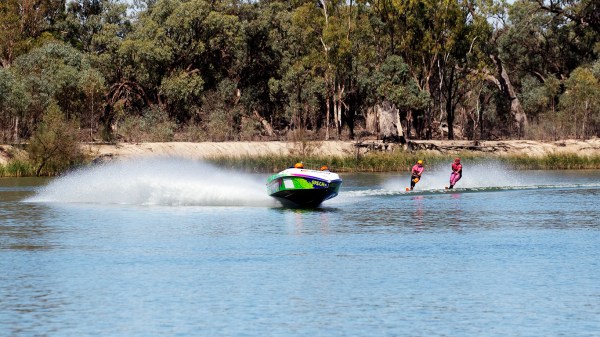
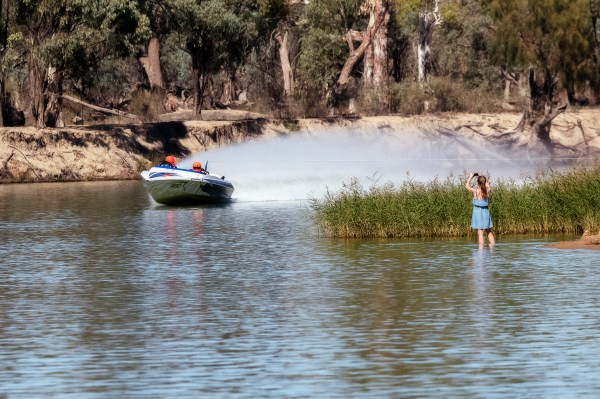
On Easter Sunday we were treated to a Ski Racing Demonstration by the Mildura Ski Club. This was in preparation for the Mildura 100klm race on the 20th April. It was a quite exciting spectacle to watch although there were only 20 boats most towing two skiers.

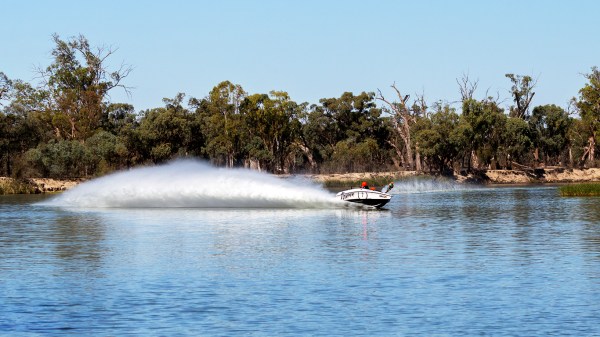
The ski ropes were extremely long – around 100 mtrs. Most boats were powered by 300hp outboards but a few were big bangers and one was turbocharged running ethanol fuel. They certainly could be heard approaching from quite a distance away as the river here is quite serpentine.
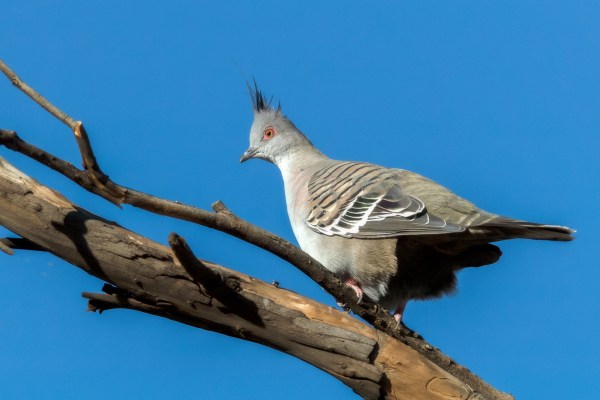
On Easter Monday most of the party goers packed up and went home and it became quite tranquil here. We had a visit from a two metre long lace monitor who hung around long enough for some photos. The birdlife here is quite shy and it is difficult to get a good shot but I did manage a reasonable shot of a Crested Pigeon. This was the first time that I used my new (2nd hand) Canon 200-400mm f/4L with 1.4x extender which I purchased for $9K in May last year just before the COVID lockdowns. This was going to be my goto lens on a trip I had planned to Namibia which did not eventuate due to international travel restrictions. It will get good use on this trip out into the back blocks of Australia.

Greg has had limited success fishing with only one under sized cod (returned to the water to grow bigger) and a couple of European Carp (dispatched).
The days now are quite idyllic with the temperature hovering in the mid 20s and the nights crisp and cold. Last night we lit our first fire at this campsite which was nice. The stars are out in their millions but the Milky Way is not quite in the right place for the astro photography that I want to try. That will start late in April or early May.

Mungo NP is still booked out a fair way in advance but we finally have a booking for 3 days starting the 19th April. We may shift to Yanga NP but are waiting on our flu shots this Friday if they get stock into the chemist we are booked into in Mildura. As for the COVID jabs they still seem a long way away and are not high on our priority list.
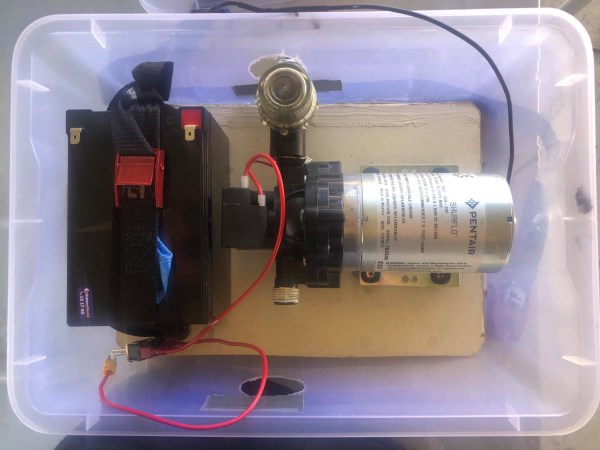
Starting to replenish our water supply from the river now using our small water pumps powered by a motorcycle battery. After double filtering the water it comes out extremely clean and drinkable. We had to rebuild mine as the battery had died. Discussed the issue with the local BatteryWorld manager who told me that even though the battery was less than two years old dry cell batteries need to be used and charged often otherwise they will fail. Lesson learned and won’t make that mistake again. We both carry 90 mtrs of hose in case we are a fair distance from the water source and the pump is strong enough to draw water that distance. If further away we can even piggyback the pumps to pump further.
Until next time…………………………………………
Lake Crosbie (Pink Lake)
Posted on March 30, 2021

We left Lake Boga and its very noisy caravan park with a change in plans due to the weather in NSW. Mungo NP was closed until the roads dried out so I decided to take Greg & I across to Lake Crosbie in the Murray-Sunset NP in the NW of Victoria.
This is a lovely part of Victoria which is accessible by 2WD provided you stay within the Pioneer Drive around the lakes. There are some great 4WD tracks to the north but they have deep sand sections and I recommend you only do these in a group of vehicles for safety.
But firstly, we traveled to Sea Lake just south of Lake Tyrell. For some strange reason this had become a very special place for Chinese tourists prior to COVID. The town is very small with one pub, two cafes & a small supermarket. Imagine their surprise when they were inundated by coachloads of tourists coming to visit Lake Tyrell 10 klm to the north every day.
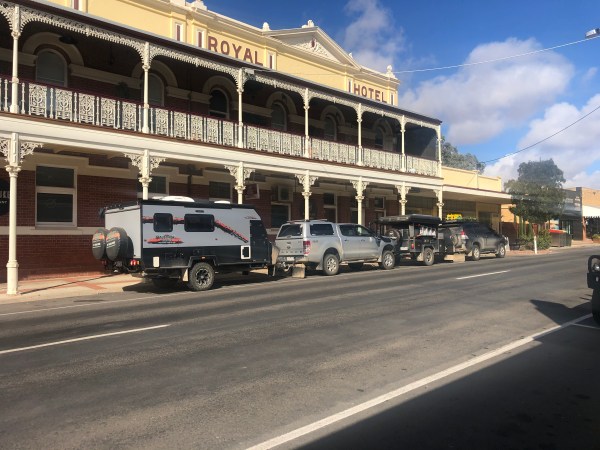
Lake Tyrell is the largest salt lake in Victoria and is a sight worth visiting. When I first came here some 8 years ago, I witnessed my first tornado in the making which hit Strathmerton later that afternoon. There is a large salt producer (Cheetham Salt) that harvests nearly 200,000 tonnes of salt from this lake annually mainly for stock licks. We didn’t stop long, just enough for the obligatory photo from the viewing platform before continuing on to Patchewollock.
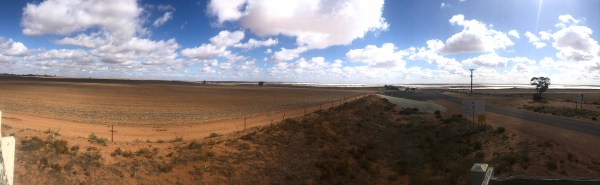
The very small town of Patchewollock claim to fame is its magnificent silo painting. I have included a photo for you to see this magnificent structure. It has become something of a feature in these small towns in all states where artists paint these fantastic murals on a huge scale. To learn more, look up Silo Trials in Australia. You will be surprised how many there are and how well done they are.
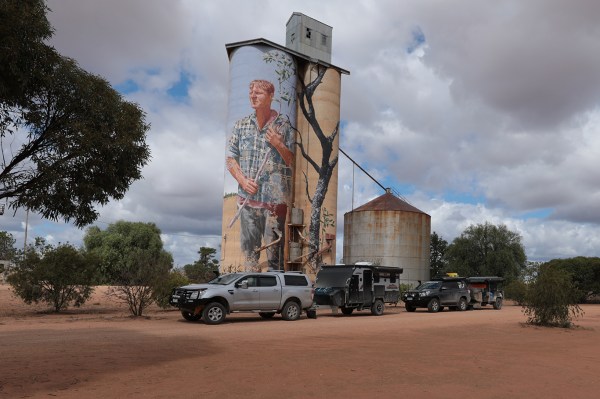
From there we headed north to Walpeup and Underbool then turned north off the highway just short of Linga up to the Murray-Sunset NP. The countryside around here is very dry even though most of the eastern seaboard of Australia is deluged by a significant rain event. They have had only 4 points of rain out here since November – that is less than 1mm! The clouds come over threatening rain but there was nothing to be had and the land is parched.
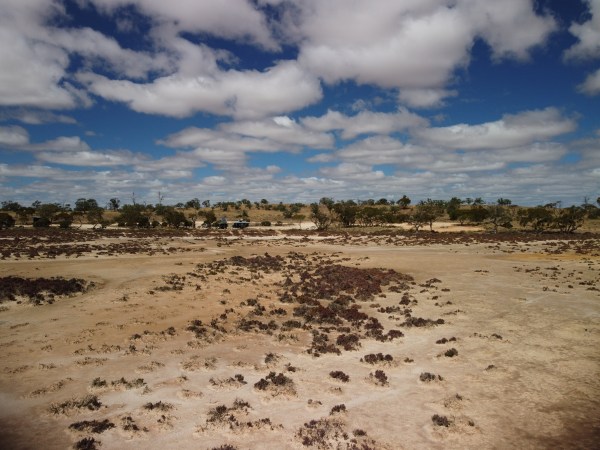
Lake Crosbie campground is a lovely spot to camp. Parks provide two drop toilets (one can cater for wheelchairs) plus a tap which provides non-potable water. The local Noisy Miner birds hang out around the tap hoping that someone will come and turn the tap on so they can get a drink. It is extremely peaceful here sitting under my awning gazing out at the pink salt lake with only the birdsong for company. There are other campers but they are far enough away not to hear them. I have setup a watering hole for the Noisy Miners next to our camp by digging a small hole and placing a steel bowl in the ground big enough for them to drink and bathe. The water I change twice a day as they are a bit dusty which turns the water to mud. It took them less than 5 minutes to find this new water source and a group of ten or so birds drink here now.

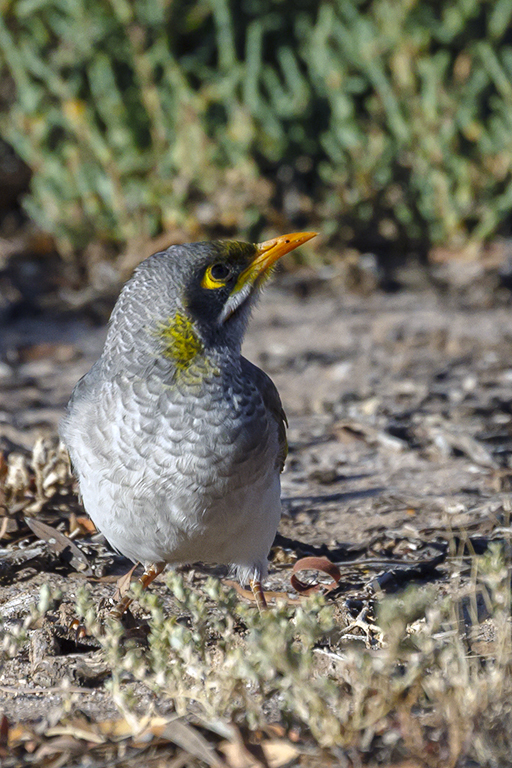
The ring neck parrots are a lot more cautious but I did hear them very early this morning as I was watching the dawn from upper story.
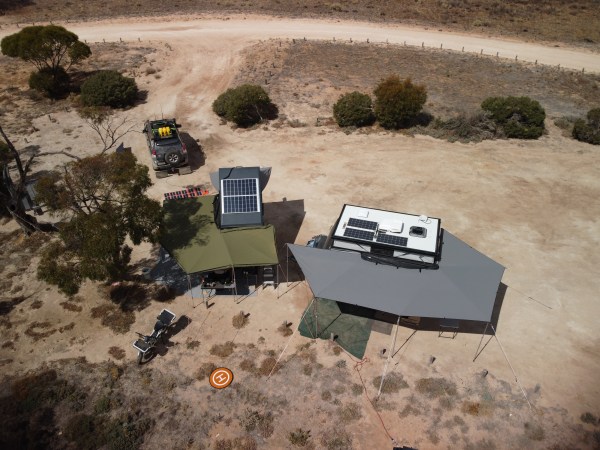
This area has an interesting history as the salt was harvested up until 1979. It is hard to imagine the hardships faced by the pioneers working out here in the summertime when the daytime temperatures average 40+ degC everyday and your water has to be delivered from Underbool some 25klm away. In one of the lakes (there are three main ones) you can see where cord roads of trees were built out into the lakes to support the equipment used for harvesting the salt. It would have been a barren existence full of hardship back in the 1800s & early 1900s. They even built a camp out here for POWs (Prisoners of War) to help with the harvest in the Second World War.

Winter is coming as most nights are clear and it is chilly enough to light a fire for warmth. Greg has made the decision to leave his van here but do a dash back to Wodonga to pickup his generator and fuel to supplement his solar due to his ongoing power issues. It will be a long day for him as it is roughly a 1000klm round trip in a day. He left at 6am and I expect him back around 6pm tonight. The plan is to stay here one more day so we can replenish Greg’s power before moving on. We will need to get to the bottom of this and will consult with an auto electrician on our way through Mildura.
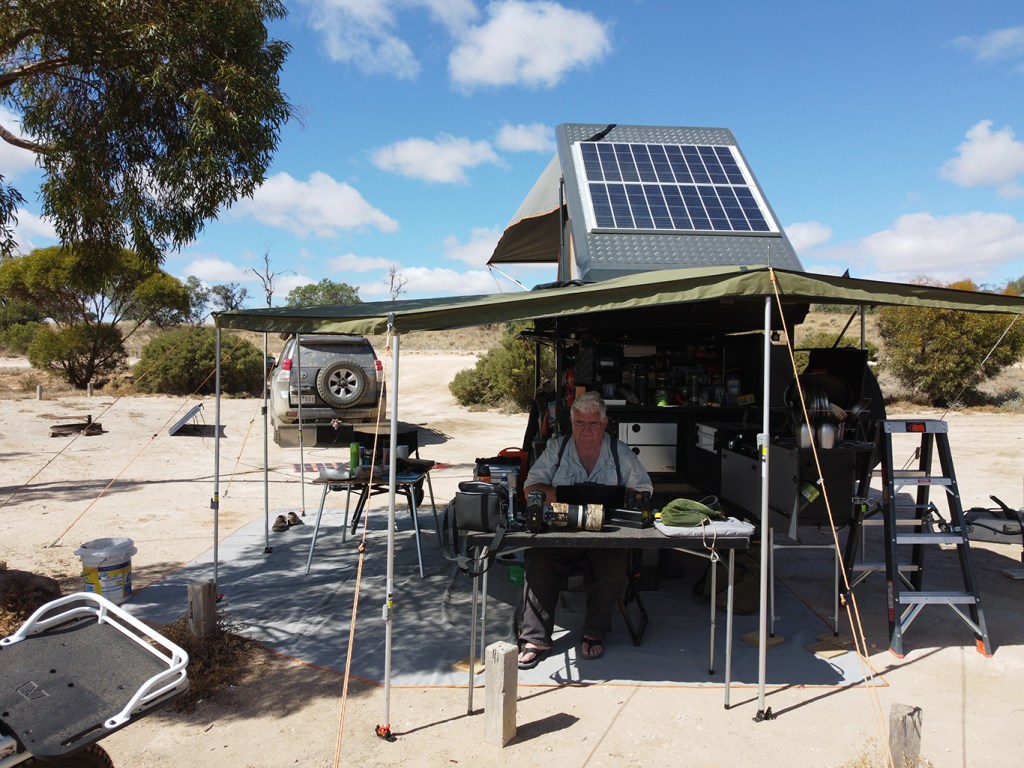
So, Tuesday hopefully we can book into Mungo NP and stay there for seven days but cannot book just yet due to there being no service out here. If we cannot get in there, we will find another suitable place and first on my list would be Gluepot just north of Waikerie in South Australia which is a Bird Australia property. Although it is not the best time of year to visit to see a lot of birds which is in Spring it will be a nice place to revisit. Springtime is when birds are in all their glory with their new/dusted off breeding plumage so we still may do Gluepot on the way back in late September. We will see.
Until next time…………………………………..
Home To Lake Boga
Posted on March 27, 2021
Lake Boga – Days 1 to 4 of 180
Well, we are finally under way. Unfortunately, it was raining but that couldn’t dampen our enthusiasm to be finally started.

The trip today was 360 klms with rain showers all the way. One benefit was that it was a cool day for driving so no stress on the vehicles. My average fuel consumption was 16.5 litres per 100 klms. One thing I had realized is that the largest cost for this trip will be fuel so I will keep a running total as it may be of interest to some of you when I fill up.
Our nice clean vehicles are now filthy as the last 10 klms into Lake Boga was across roadworks which was very muddy and slippery.
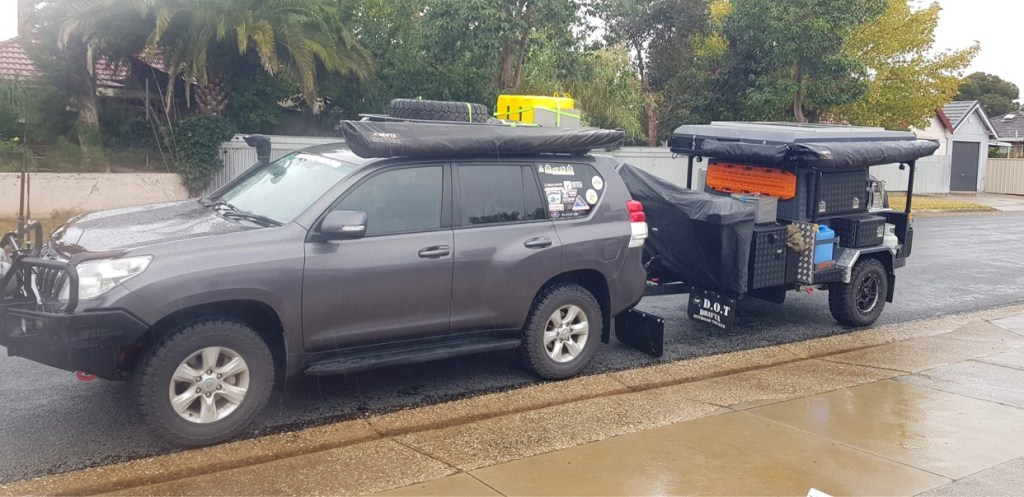
Here it is nice and clean (above) and now the mud (below). Will not be washing it for awhile as we have many other dirt roads to get through in the coming weeks.
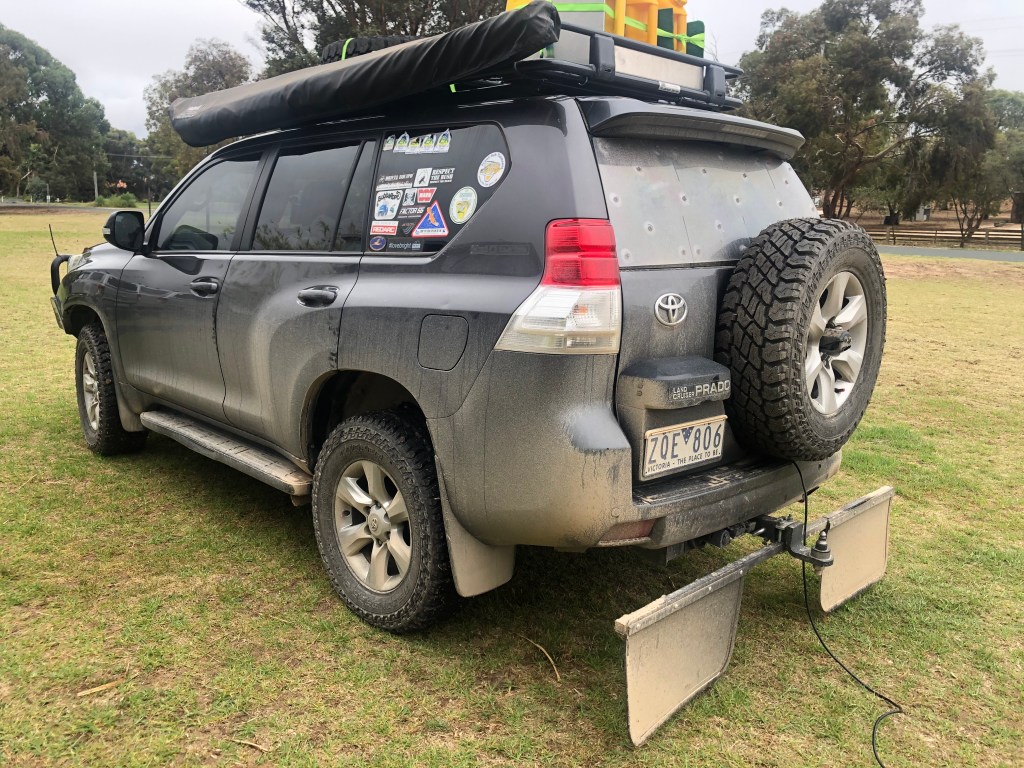
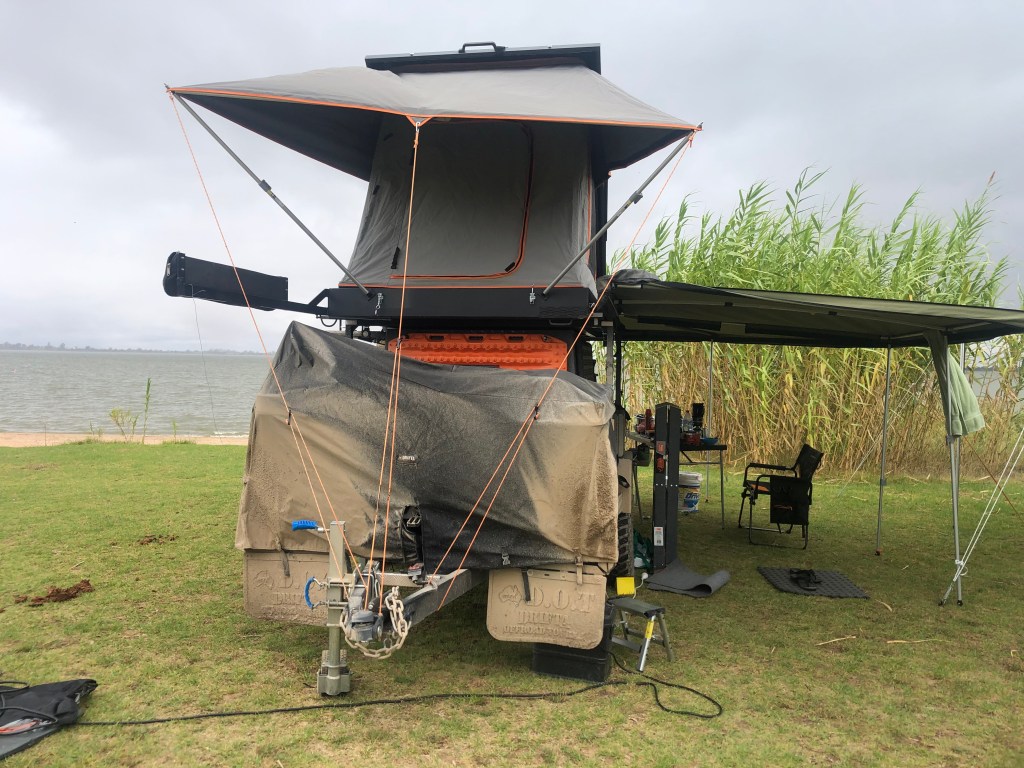
As you can see behind the trailer the weather is very ordinary here at the moment with a few showers and a cold wind thrown in. We have had three days of this now and the batteries are going down. This morning mine was at 61% and Greg’s is down to 41%. Very happy with mine as you can run Lithium batteries down a lot further than AGMs. At this rate with no solar input, I can last another two days at least before I need to start the car and plug the trailer in to charge the battery. In the planning stages we had decided that we would be off grid without having a petrol generator which is saving on space and the carrying of petrol. All our power would come from our vehicles whilst driving or from the solar on our roofs plus blankets. Solar blankets are out and even with minimal sun the batteries are charging albeit very slowly.
My trailer has 380 watts of solar units plus I have a high capacity 250w solar blanket to help charge the Enerdrive 200aH Lithium battery. For the car I have a Baintech 180w portable solar blanket to help charge the 72aH Topograghy lithium battery which runs the fridge & the travel buddy oven (to heat up pies & pizza on the road – it will cook a roast in a pinch although it would take a while).
We may have to change our plans slightly as this rain event has forced road closures to the north of us in Mungo NP. All the places we intend to visit are also closed or under advisement of closure and may take some time to dry out. Our stay here has now been extended so we are busy planning the alternates. This was why I have not booked anything in advance so we would have the most flexibility.
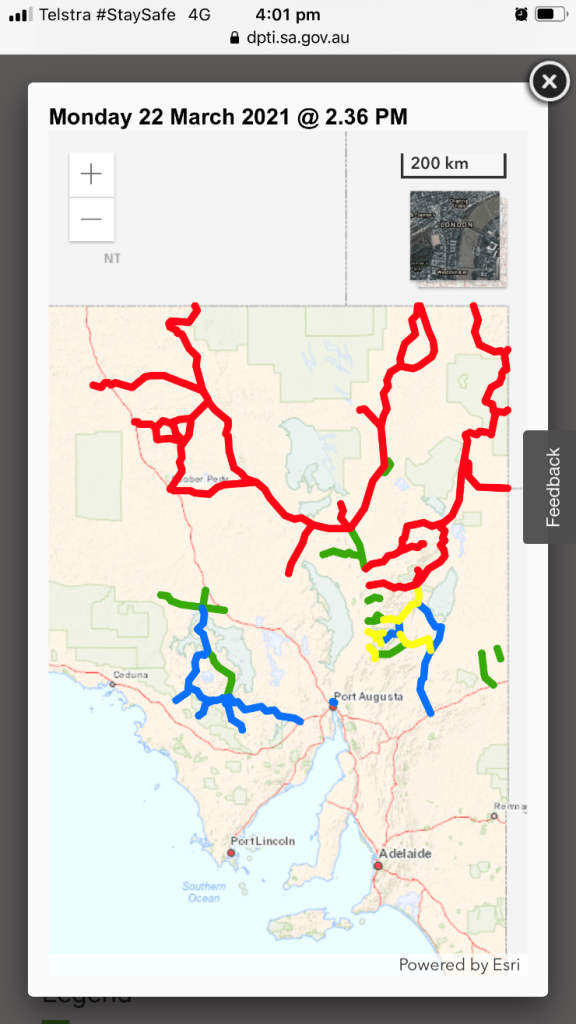
I snapshotted this image from the South Australian roads department. Our plan is to take the Oodnattta Track up into the Northern territory via Wilpeena Pound. As you can see from the image those roads in RED are closed to all travel, YELLOW advised not to travel, BLUE under advisement and GREEN are open. We will be watching this site for updates although current plan does not put us into this area for at least 30 days.
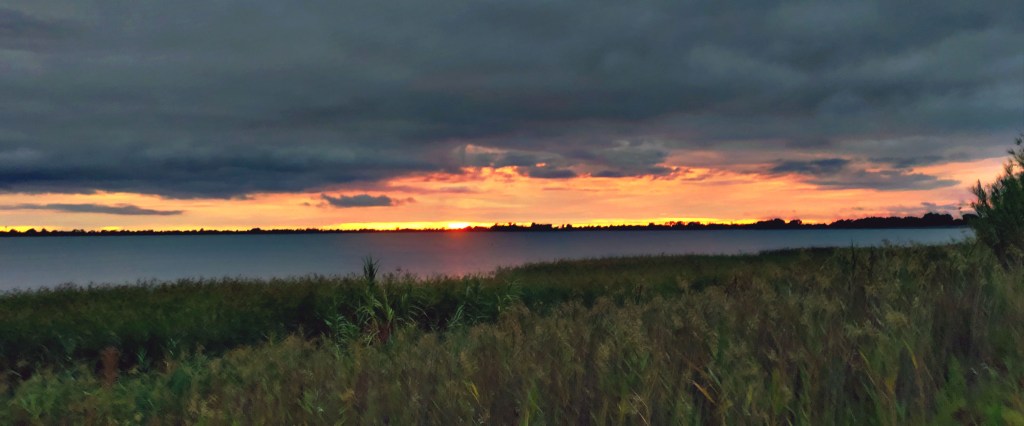
Sunset last night was a bonus even if it was cloudy. This was taken on my iPhone. There is some birdlife around us and the following two images were taken using my Canon 1D x & a Canon 100-400mm f/3.5-5.6 IS USM lens. The big guns are still sleeping in their bags in the back of the car waiting for better opportunities. Here two shots to show what was next to our camp.
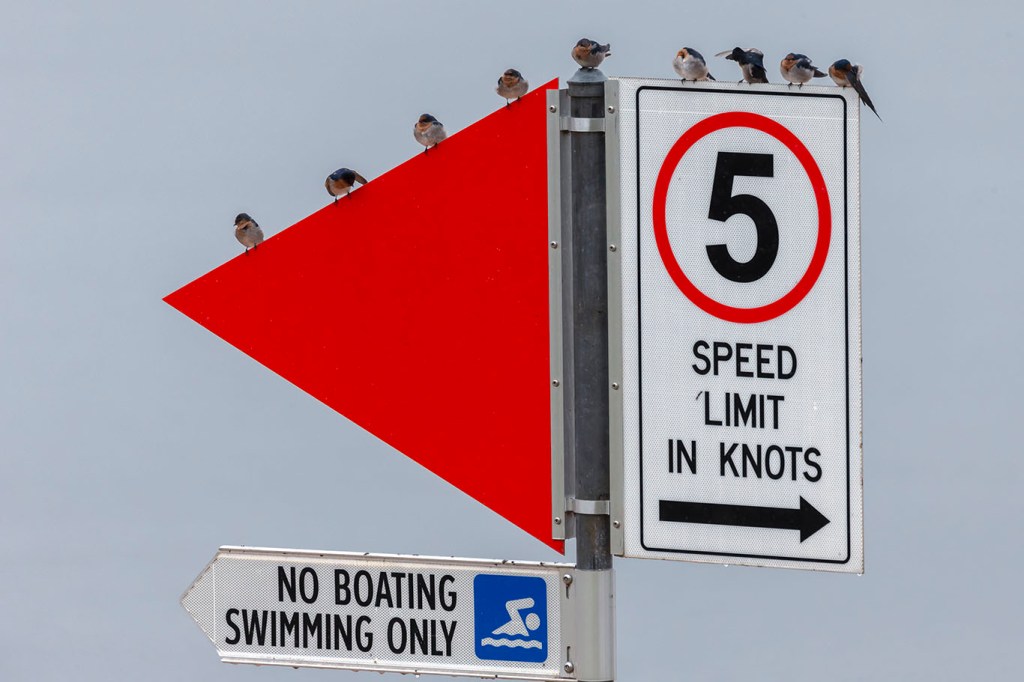
Welcome swallows will use anything for a perch
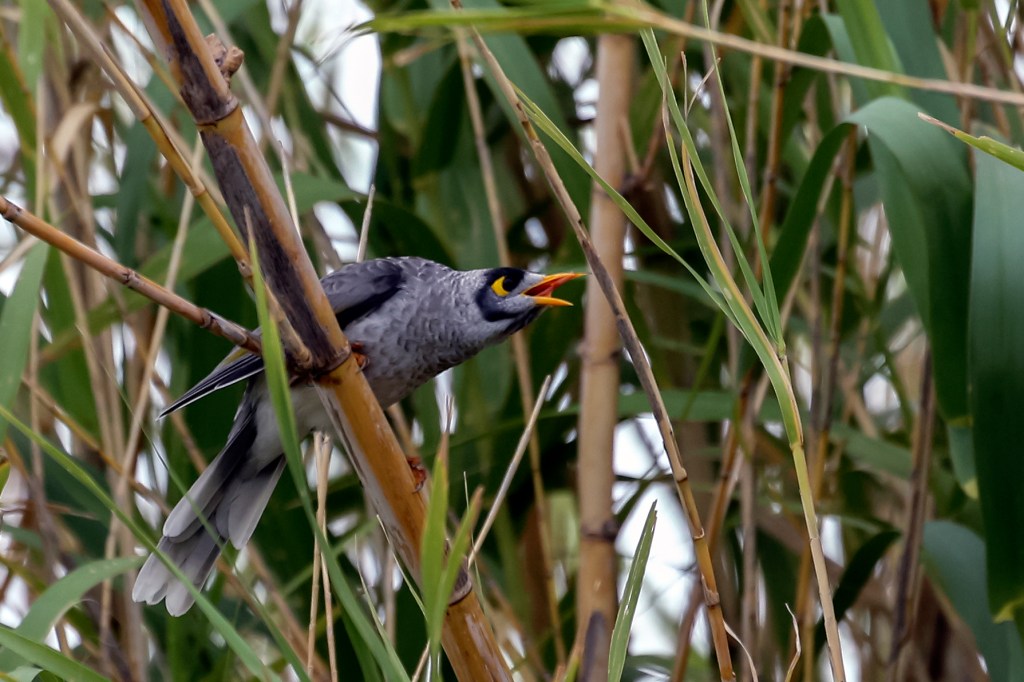
Noisy Miner telling his friends where the food was.
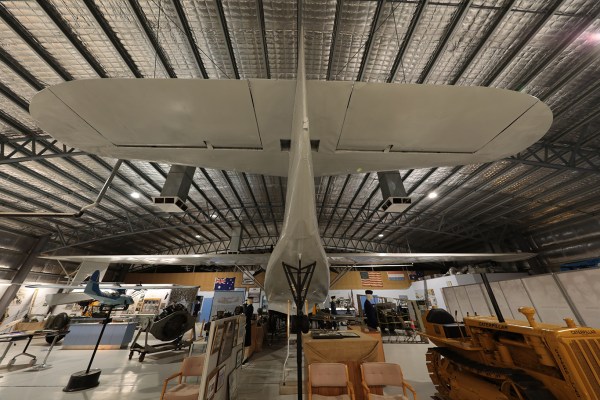
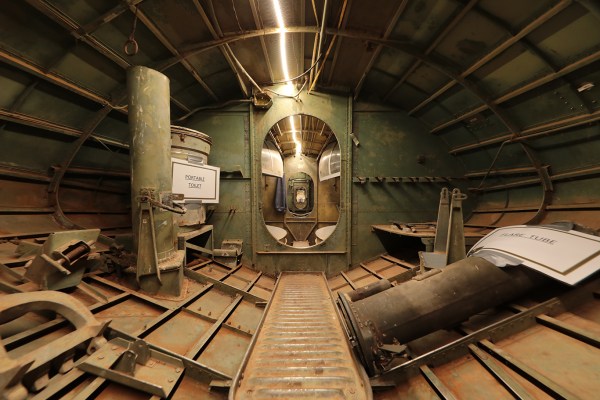
The main reason our first stop was in this small town was to see the Catalina Museum. A very good small museum with a PBY-5 Catalina restored from parts found in the local countryside by the local Lions Club. The airbase was setup here in secret in 1942 as there was a major fear of the Japanese invading Australia at the time. It was a major airbase for all types of seaplanes from not only the Australian Air Force but the Dutch Air Force and then the United States Air Force. Many different aircraft types were rebuilt and repaired here including Consolidated PBY Catalinas, Martin PBM Mariners, Sunderland Flying Boats & the Vought OS2U Kingfisher. From here aircraft were launched back into the fray to bomb & mine Japanese bases all through New Guinea and as far north as Hong Kong. It was closed in 1947 and many of the remaining aircraft and their parts were sold for scrap. A sad ending to some of the most graceful aircraft that ever flew.
As a child I was lucky enough to fly on a TAA Sunbird flight using Catalinas from Daru, where my parents were teachers, to Port Moresby. It was very exciting sitting down the back under the cupolas as the mighty engines roared and the water cascaded over me as it plowed down the Fly River to get to takeoff speed. So, I have always been fascinated by old warbirds turned to peaceful purposes but that is another story of my growing up in a strange land.
Here are some shots
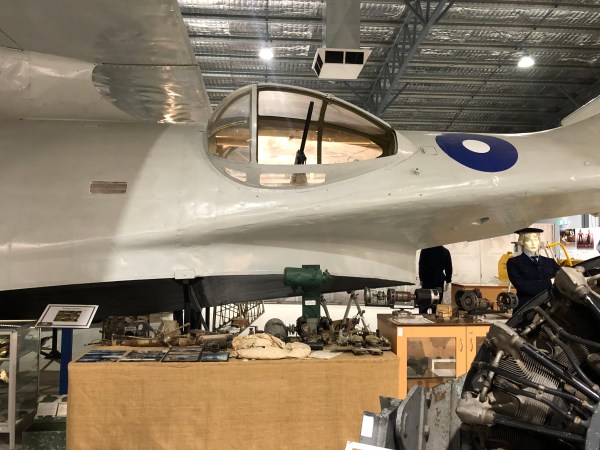
And finally, one from Greg as he starting to learn a new skill using my Canon M6 with an adapter onto a canon 70-200mm f/2.8L IS USM II. Not bad with a little coaching.

After being forced to move after four days of rain and heavy cloud due to Greg’s critical battery power situation we stayed for one night in the Lake Boga Caravan Park. Whilst it was very nice and the amenities were clean the night noise of the trucks rattling by all night meant a very bad nights sleep. Sorry but I could not recommend this stay to anyone. however the camping spots without power on the other side of the lake with toilets and showers but no power were excellent value at $7.50 a night.
Today we have finished packing and on our way to Lake Crosbie in Murray – Sunset NP just near Underbool. This journey will be via Sea Lake, Lake Tyrell, Patchewollock, Walpeup & Underbool – a drive of 4 hours but that will be in the next instalment.
Until next time…………..
The Journey Begins……..
Posted on March 20, 2021
My cousin Greg & I have been working on the trip planning for nearly two years now. Originally I was going to do the journey solo when I purchased my Drifta Offroad Trailer (DOT358). Sadly these are no longer manufactured but the Drifta business is still going strong. I personally believe they were the best built camper trailer in Australia and this one was custom built to my specifications. Will add the specifications sheets in the blog soon for those that may be interested when they come to specify what they want/need in a camper trailer.
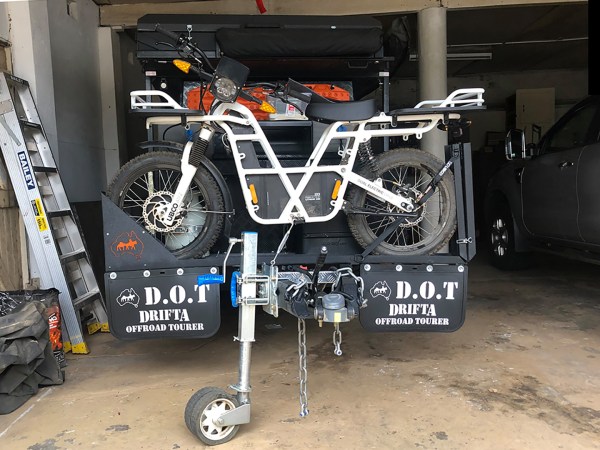
DOT358 at Greg’s finalising plumbing modifications
Greg became very excited when I talked about travelling the outback to take landscape and bird photographs through the deserts of NSW, SA. NT & Western Qld. So much so that he sold his 23 ft van and downsized to a AusTrack Tanami X13 offroad van so he could accompany me. We have been mates for years loving camping and fishing together. Our wives were very good friends but sadly both have passed away in recent years leaving the boys to go bush and have fun.
I had not realised how much work was involved to ensure that not only would we be safe on our travels but that our vehicles and trailers would be rugged enough to survive as well. In my case my Toyota Prado 150 GXL needed upgrading to ensure insurance compliance with overall weight and load distribution. Originally I had added lots of ‘fruit’ to the vehicle as I had no intention of dragging a caravan or trailer around on my journey so I had a rooftop tent installed. As I got older this became less comfortable and inconvenient so I started researching camper trailers as I still do not like caravans. When I bought the vehicle I had my friends at ARB in Albury fit a bullbar & winch, underbody steel plate protection (bash plates), a drawer system with a cage, driving lights, roofrack with ARB Simpson tent & a 12v 48 ltr Fridge/Freezer plus upgraded the tyres to Coopers ST-Maxx. Never once did I consider the impact of adding all this weight to the vehicle. After awhile I was back to ARB to have an Old Man Emu 2″ lift kit put in after giving the bash plates a hiding exploring the tracks in NE Victoria. This rig was a delight to drive and gave me many years of fun. When I started to do some research on travelling in the outback in style my needs changed .
It was fun doing the research on how people had prepared their vehicles to go out and enjoy the great outdoors of Australia. Here was where I began to hear about issues with vehicle weights and potentially how dangerous this can be. Not the sort of thing you want to hear when all you want to do is go out there and have fun. So I decided to investigate to see if I was compliant. Shock, horror I was not even close. I imagine most 4WDs will be in the same boat. For my Prado it has a GVM (Gross Vehicle Mass) of 2990 kg fully loaded and a Kerb Weight of 2265 kg. This allowed for 725 kg of load – sounds a lot but in reality is not. Remember the ‘fruit’ I had added? Now was the time to do some sums – to cut a long story short I was over even before I hopped in and added my camera gear let alone added a camper trailer onto the hitch for towing.
More investigation meant my options were limited – 1. Replace the vehicle (too costly – rejected); 2. Remove some of the ‘fruit’ (Many are to protect the vehicle so option rejected); 3. Remove and leave behind some of my portable gear (A lot this is safety/recovery gear – option rejected) & finally 4. Bite the bullet and get a GVM upgrade which will give me another 350kg of payload capability but at a significant cost ($4500 AUD). So after much procrastination I bit the bullet and went with Option 4. I am now legally compliant to tow my camper trailer plus take all my camera gear when I travel. We did the same assessment on Greg’s vehicle ( a Ford Ranger) but it was Ok but decided to add a bullbar, underbody protection, driving lights & recovery points because of where we were going.

Next was to figure out what spares and tools we would need to carry which we trimmed down to spare hoses, air filters and fan belts for the cars. Tools we already had included socket sets, spanners, pliers and No 8 fencing wire (plus fencing pliers). The last we felt was a prerequisite for all bush mechanics if something starts to fall off!! We are also carrying pop rivets, anderson plugs, wiring, crimping tools, drills & drill bits. You can see by now much preparation was required to journey off the beaten track as mechanics & spares will be few and far between where we are going. As an added precaution we are both carrying a spare tyre hull plus I have two spare tubes (these are just in case we rip/split the wall of the tyres we have and cannot patch them.
All of that work has now been completed and both vehicles have had a thorough service plus my trailer and Greg’s caravan so from a preparation side that is now complete. Topped up the fuel & water tanks plus loaded the MaxxTrax & three spare fuel containers up onto my roof rack (these won’t require filling until we hit the dirt roads of outback South Australia). Everything now tied down with only camera gear & clothes to load into my car plus load the dry food container onto the back of my trailer. These are all the small luxuries you like to have when you are free camping out in the bush – vegemite, jams, pickles, S&P, sugar, flour, rice, noodles. For a lot of our initial journey we will have access to supermarkets but once out in the desert they will be few & far between so it is wise to pack them before leaving home. Prior to leaving both Greg & I have made prepared meals for two and frozen them and they include curries, stew, soups & roasts (pre-cooked, sliced and cryovacced) enough to last three weeks off-grid.
Both of us have full kitchens on board our trailer/caravan which I will show in another blog once we are on the road. All our gear was given a thorough test when we camped on the edge of Blowering Dam for three weeks last December. So, no more gear required to buy it is time to do the final packing. One more sleep and we will be on the road. First stop is Lake Boga near Swan Hill.
 TurningDieselIntoMemories